

Cleanroom glossary
Short, plain definitions of the grades, standards, fabric and garment terms that come up when you specify cleanroom apparel.
A
- ANSI/ESD S20.20
- A standard for electrostatic discharge control programmes that protect electronic parts. It sets limits for wrist straps, flooring, work surfaces and static control garments. EN 1149-5 vs ANSI/ESD S20.20
- Aseptic processing
- Manufacturing a sterile product from sterile components in a controlled environment, without terminal sterilisation of the final product. Operators in these areas wear a full sterile gown.
- Autoclave
- A pressure vessel that sterilises items with saturated steam, commonly at 121 °C or 134 °C. Reusable cleanroom garments are usually autoclaved after laundering. Autoclave cycle life
- Autoclave cycle life
- The number of laundering and sterilisation cycles a reusable garment is designed to survive while still meeting its performance specification. Garments are tracked so they are retired on time.
B
- Bootie
- A knee-length or calf-length overshoe worn over cleanroom footwear, with the coverall leg tucked inside. Sterile booties are part of the Grade A and B gown. Cleanroom booties
- Bouffant cap
- A gathered, elasticated head cover that contains hair in lower grade areas such as Grade D and ISO 8 rooms. Head caps
- Bound seam
- A seam whose raw edges are enclosed by binding tape or folded construction so fibres cannot escape from cut fabric edges.
C
- Carbon grid fabric
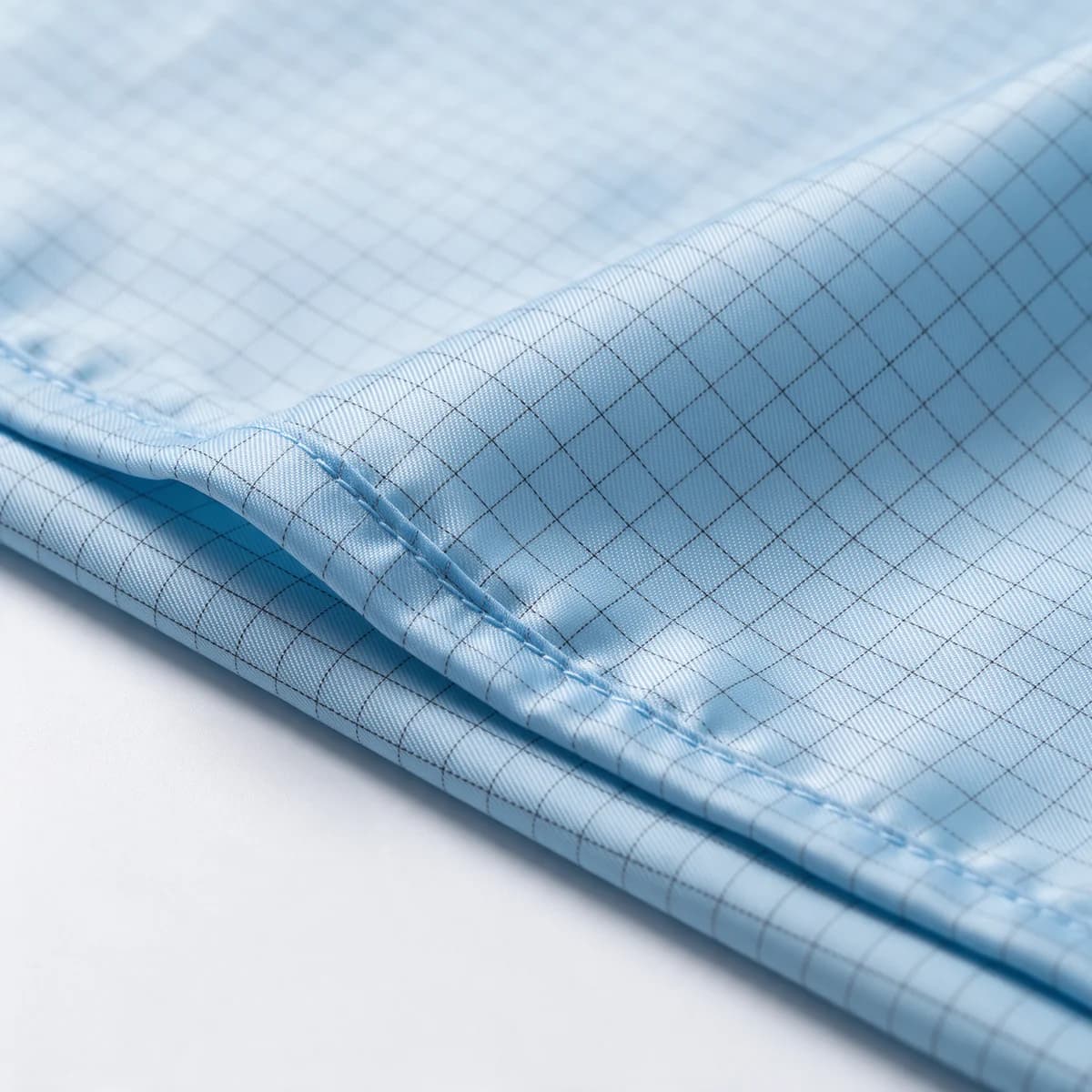
- Polyester fabric woven with conductive carbon yarns in a grid, typically every 5 mm, so static charge dissipates across the garment. Stripe fabrics run the yarn in one direction only. Antistatic fabrics explained
- Certificate of conformity
- A document issued with a batch confirming the goods meet the agreed specification. QA teams usually require one for every delivery.
- Charge decay
- How quickly static charge drains from a fabric, measured in seconds. Shorter is better. EN 1149-3 is one test method.
- Cleanroom
- A room in which the concentration of airborne particles is controlled and classified, and in which other parameters such as temperature, humidity and pressure are controlled as needed.
- Contamination control strategy
- A planned set of controls, required by EU GMP Annex 1, that covers how a sterile site prevents microbial, particle and endotoxin contamination. Gowning and garments are part of it.
- Continuous filament polyester
- Yarn made from unbroken synthetic filaments. It sheds far fewer fibres than spun yarns or cotton, which is why it is the standard fabric for cleanroom garments.
- Coverall
- A one-piece suit covering the body, arms and legs, worn as the main cleanroom garment. Styles include stand-up collar and attached hood. Cleanroom coveralls
E
- EN 1149-5
- European standard for protective clothing with electrostatic properties, used where a spark could ignite a flammable atmosphere. The fabric must meet a surface resistance or charge decay requirement. EN 1149-5 explained
- EU GMP Annex 1
- The European guideline for manufacturing sterile medicinal products, revised in 2022. Section 7 sets gowning expectations for each cleanroom grade. Annex 1 gowning requirements
F
- Filtration efficiency
- The share of particles of a given size that a fabric stops when air passes through it, usually reported at 0.3 µm and 0.5 µm.
G
- Gowning qualification
- Training and assessment that shows an operator can put on cleanroom garments without contaminating them, often confirmed with microbial sampling of the gown. Repeated periodically. Gowning sequence
- Grade A
- The EU GMP zone for high risk aseptic operations such as filling and making sterile connections. Equivalent to ISO 5 for particles at rest and in operation.
- Grade B
- The background environment for Grade A in aseptic processing. ISO 5 at rest and ISO 7 in operation. Operators wear the full sterile gown.
- Grade C
- A clean area for less critical steps in sterile manufacturing, such as solution preparation. ISO 7 at rest and ISO 8 in operation.
- Grade D
- The lowest EU GMP clean area grade, used for support activities such as component handling. ISO 8 at rest.
H
- Helmke drum test
- A test that tumbles a garment in a rotating drum while counting released particles. Described in IEST-RP-CC003 and used to compare garments and track them over their life. IEST-RP-CC003 explained
- Hood
- A head cover that encloses hair, ears and neck, with the lower edge tucked into the coverall collar. Required as sterile headgear in Grade A and B. Hoods and masks
I
- IEST-RP-CC003
- The Institute of Environmental Sciences and Technology recommended practice on garment system considerations for cleanrooms, covering fabric, construction, testing and processing. IEST-RP-CC003 explained
- ISO 13485
- International standard for quality management systems for medical device organisations. Many pharma and device QA teams look for it when qualifying garment suppliers. Our quality system
- ISO 14644-1
- International standard that classifies cleanrooms by airborne particle concentration, from ISO 1 (cleanest) to ISO 9. Garments by ISO class
- ISO 9001
- International standard for quality management systems, covering how an organisation controls processes, documents and improvement.
L
- Lint-free
- Describes a material that releases very few fibres in use. In cleanrooms it usually means continuous filament synthetic fabric with sealed edges.
P
- Particle shedding
- Release of particles and fibres from a garment during wear. Low shedding is a core requirement for every cleanroom garment.
R
- Reusable cleanroom garment
- A garment that is laundered, inspected and usually sterilised between uses, for a defined number of cycles. Lower cost per wear and less waste than disposables at most volumes. How long reusable garments last
S
- Sterile garment
- A garment that has been sterilised, typically by steam autoclave or gamma irradiation, and kept in sealed packaging until use. Required in Grade A and B areas.
- Surface resistance
- The electrical resistance measured across the surface of a fabric, in ohms. Lower values mean charge spreads and dissipates more easily.
U
- Undergarment
- A lint-free top and trouser set worn under the coverall in place of personal clothing, to reduce particles from street clothes. Undergarments
Tell us what your cleanroom needs
Share your ISO class, quantities and timelines. We reply with options, a quote and sample availability within one working day.