

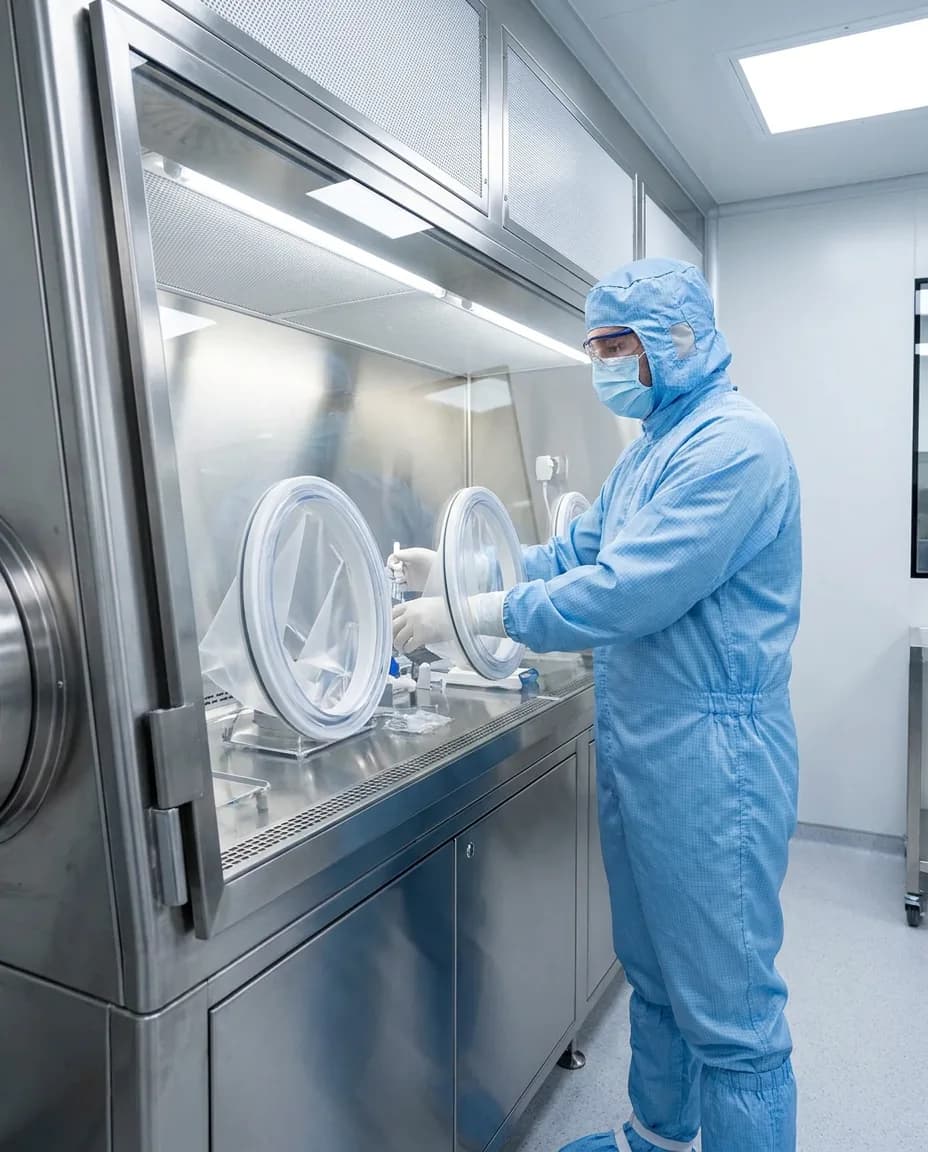
EU GMP Annex 1The European guideline for manufacturing sterile medicinal products, revised in 2022. Section 7 sets gowning expectations for each cleanroom grade., Manufacture of Sterile Medicinal Products, was revised in 2022 and has applied since August 2023. Section 7 covers personnel, and it sets out what operators should wear in each cleanroom grade. This guide translates those expectations into a garment specification. It is written for QAQuality assurance: the system and team that make sure products and suppliers meet requirements., production and procurement teams, and it is not a substitute for reading the guideline itself.
The short version
| Grade | Typical activity | What operators wear |
|---|---|---|
| Grade AThe EU GMP zone for high risk aseptic operations such as filling and making sterile connections. Equivalent to ISO 5 for particles at rest and in operation. | Aseptic filling, open product, sterile connections | Worn inside a Grade BThe background environment for Grade A in aseptic processing. ISO 5 at rest and ISO 7 in operation. Operators wear the full sterile gown. background. Same gown as Grade B. |
| Grade B | Background for Grade A | Sterile hood, sterile coverall, sterile booties, sterile mask, sterile eye cover, sterile gloves. Low shedding fabric. |
| Grade CA clean area for less critical steps in sterile manufacturing, such as solution preparation. ISO 7 at rest and ISO 8 in operation. | Solution preparation, less critical steps | Covered hair, beard and moustache. Single or two-piece trouser suit gathered at the wrists with a high neck. Dedicated shoes or overshoes. Low shedding fabric. |
| Grade DThe lowest EU GMP clean area grade, used for support activities such as component handling. ISO 8 at rest. | Component handling, washing, support areas | Covered hair and beard, general protective suit, dedicated shoes or overshoes. |
Grade A and B: the full sterile gown
For aseptic areas Annex 1 expects a complete barrier that has been sterilised before use:
- Sterile headgear that encloses all hair and facial hair, tucked into the neck of the suit. A hood is the usual choice.
- A sterile face mask and sterile eye coverings such as goggles.
- A sterile coverall that sheds virtually no fibres or particles and retains particles shed by the body.
- Sterile footwear or overboots, with the trouser legs tucked inside.
- Sterile, powder-free gloves, with the garment sleeves tucked into the gloves.
In garment terms that means a coverall with knitted or elasticated cuffs and a closable collar, a hood that overlaps the coverall neck, knee-length booties with a grip sole, and a mask that stays in place without adjustment. Every piece should be compatible with your sterilisation cycle, which for reusable garments is usually steam autoclaving.
Grade C and D: protection with fewer layers
Grade C still calls for low shedding garments and full hair cover, but the suit does not need to be sterile in most processes. A two-piece suit is allowed, provided it is gathered at the wrists and has a high neck. Grade D is the lightest grade: a general protective suit, hair cover and dedicated footwear.
Many sites still choose one fabric for all grades and change only the garment style and colour. Colour coding by grade makes zone discipline easier to audit.
What Annex 1 says about reusable garments
Reusable garments are allowed and widely used. The guideline expects that:
- Garments are laundered and sterilised in a facility that is segregated and qualified for cleanroom garments, using a validated process.
- Garments are inspected for damage and are used for a defined maximum number of processing cycles.
- Garments are changed at least every time an operator enters the cleanroom, or more often if the risk assessment says so.
That makes cycle life and traceability part of the garment specification. Ask your supplier for the design cycle life, how each garment is identified (batch code, size, and ideally an individual identifier) and how you will record cycles.
Gowning qualification
Operators in Grade A and B areas should be trained and qualified in aseptic gowning, including a microbiological assessment of the gown after donning. Requalification is periodic, typically at least once a year. Garment design affects this directly. A hood that slips, a zip that is hard to close with gloves, or a bootie that is hard to fasten on a step-over bench all add touch points and risk.
Turning Annex 1 into a garment specification
Use this list when you write a specification or a supplier questionnaire:
- Fabric: continuous filament polyester, low particle shedding, with carbon grid or stripe for static control where needed.
- Construction: bound or covered seams, no exposed raw edges, enclosed zip, knitted or elasticated cuffs.
- Sterilisation: compatible with your autoclave cycle, with a stated design life in cycles.
- Identification: size, batch code and garment identifier that survive laundering.
- Documents: technical data sheet, fabric test report, certificate of conformity per batch, size chart and care instructions.
- Supplier quality system: ISO 9001International standard for quality management systems, covering how an organisation controls processes, documents and improvement., and ISO 13485International standard for quality management systems for medical device organisations. Many pharma and device QA teams look for it when qualifying garment suppliers. where your QA team requires it.
Related reading
Frequently asked questions
Does EU GMP Annex 1 require sterile garments in Grade C?
Not as a general rule. Grade C requires low shedding garments, covered hair and a single or two-piece suit gathered at the wrists with a high neck. Sterile garments are expected in Grade A and B areas. Your own contamination control strategy may still call for sterile garments in Grade C for specific steps.
Can reusable garments be used under Annex 1?
Yes. Annex 1 expects reusable garments to be laundered and sterilised with a validated process in a qualified, segregated facility, inspected for damage and limited to a defined number of cycles.
How often should cleanroom garments be changed?
Annex 1 expects a clean, sterile gown at least for every entry into a Grade A or B area, or more often where the risk assessment justifies it.
When did the revised Annex 1 come into force?
The 2022 revision was published in August 2022 and came into operation on 25 August 2023, with one lyophiliser provision following in August 2024.