

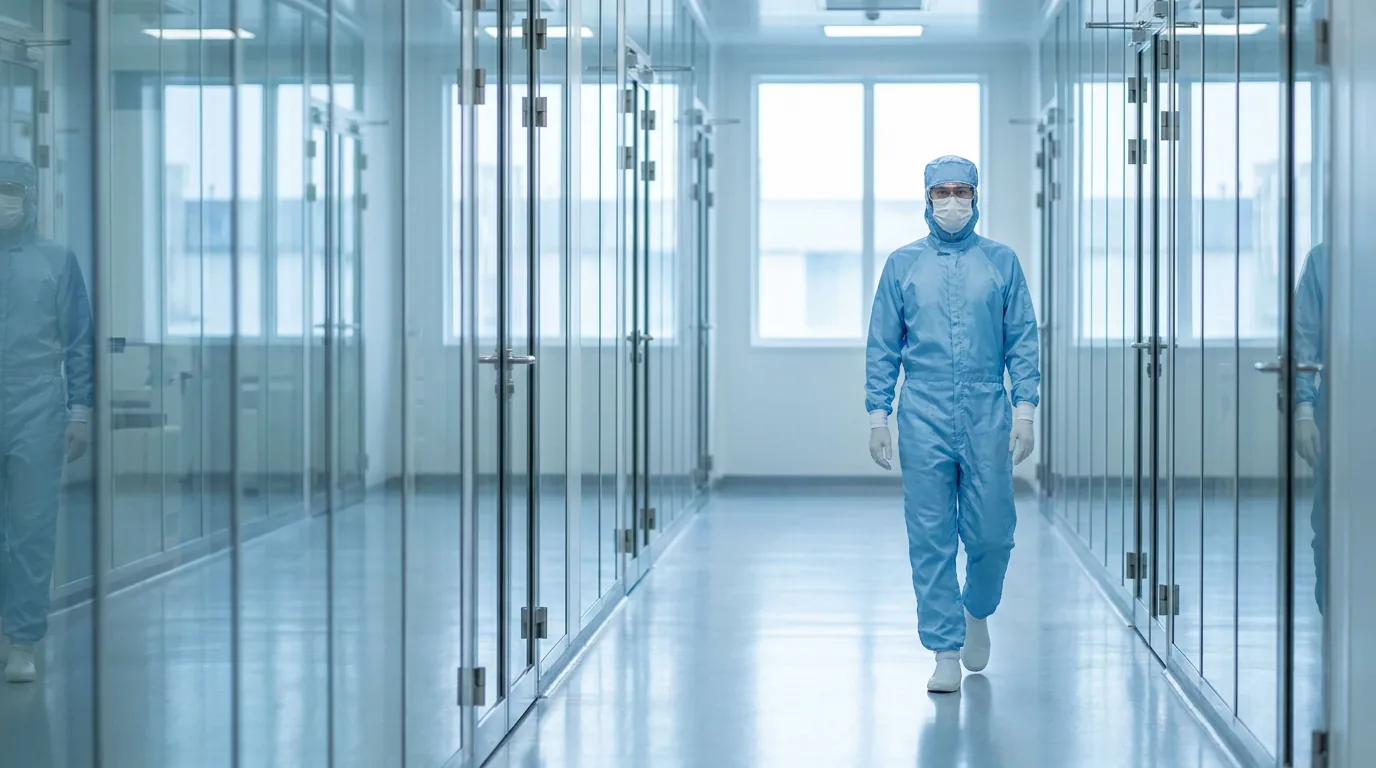
Choosing a cleanroom garment starts with one question: what class is the room? The answer sets how much of the body must be covered, whether garments must be sterile, and which fabric and construction make sense.
ISO classes in one table
ISO 14644-1International standard that classifies cleanrooms by airborne particle concentration, from ISO 1 (cleanest) to ISO 9. classifies cleanrooms by the number of airborne particles per cubic metre. The lower the class number, the cleaner the room.
| ISO class | Max particles ≥0.5 µm per m³ | Typical use |
|---|---|---|
| ISO 5 | 3,520 | Aseptic filling, sterile processing |
| ISO 6 | 35,200 | Some device and electronics work |
| ISO 7 | 352,000 | Background to aseptic areas, preparation |
| ISO 8 | 3,520,000 | Packing, gowning rooms, support areas |
How EU GMP grades map to ISO classes
EU GMP Annex 1The European guideline for manufacturing sterile medicinal products, revised in 2022. Section 7 sets gowning expectations for each cleanroom grade. uses grades A to D and classifies them both at rest and in operation.
| GMP grade | At rest | In operation |
|---|---|---|
| A | ISO 5 | ISO 5 |
| B | ISO 5 | ISO 7 |
| C | ISO 7 | ISO 8 |
| D | ISO 8 | Set by the manufacturer |
What to wear in each grade
Grade AThe EU GMP zone for high risk aseptic operations such as filling and making sterile connections. Equivalent to ISO 5 for particles at rest and in operation. and B. Annex 1 expects sterile garments: headgear that encloses all hair and facial hair, a face mask, eye protection, a sterile coverall, sterile overboots with trouser legs tucked inside, and sterile powder-free gloves over the sleeves. No skin should be exposed. This is where a sterile autoclavable coverall set with hood and booties is used.
Grade CA clean area for less critical steps in sterile manufacturing, such as solution preparation. ISO 7 at rest and ISO 8 in operation.. Hair and facial hair covered, a single or two-piece trouser suit gathered at the wrists with a high neck, and disinfected shoes or overshoes.
Grade DThe lowest EU GMP clean area grade, used for support activities such as component handling. ISO 8 at rest.. Hair and facial hair covered, a general protective suit, and disinfected shoes or overshoes.
Fabric and construction
- Fabric. Continuous filament polyesterYarn made from unbroken synthetic filaments. It sheds far fewer fibres than spun yarns or cotton, which is why it is the standard fabric for cleanroom garments. sheds very little. A conductive carbon grid adds static control, which is important in electronics and where powders are handled.
- Seams. Bound or covered seams hold fibres in and stand up to repeated laundering.
- Closures and cuffs. A zip with a storm flap, close-fitting knit or elastic cuffs and snaps for booties stop gaps opening as operators move.
Reusable or single use?
Reusable garments are laundered and steam sterilised between uses. Ours are designed for repeated steam autoclaving, so the cost per wear stays low. Single-use garments avoid laundry logistics but add waste and running cost. Many plants use reusable garments in core areas and single-use items for visitors.
A practical checklist
- List every room and its grade or ISO class.
- Decide the garment set for each grade, using the table above.
- Pick a colour per zone so garments never cross between areas.
- Trial samples with operators for fit and comfort.
- Validate laundering, sterilisation and garment life in your process.
Need help mapping garments to your rooms? Send us your room list and we will propose a gowning set.
Frequently asked questions
What should operators wear in a Grade A cleanroom?
Sterile garments that leave no skin exposed: hood or headgear covering hair and facial hair, face mask, eye protection, sterile coverall, sterile overboots and sterile powder-free gloves, as described in EU GMP Annex 1.
Is ISO 5 the same as Grade A?
Grade A must meet ISO 5 both at rest and in operation for particles of 0.5 µm and larger. Grade B is ISO 5 at rest but ISO 7 in operation.
Do Grade D areas need cleanroom coveralls?
Annex 1 asks for a general protective suit, hair and beard cover and disinfected shoes or overshoes in Grade D. Many plants use reusable coveralls or two-piece suits.